
English| EUR
Suggested for you
More currencies
Choose a language
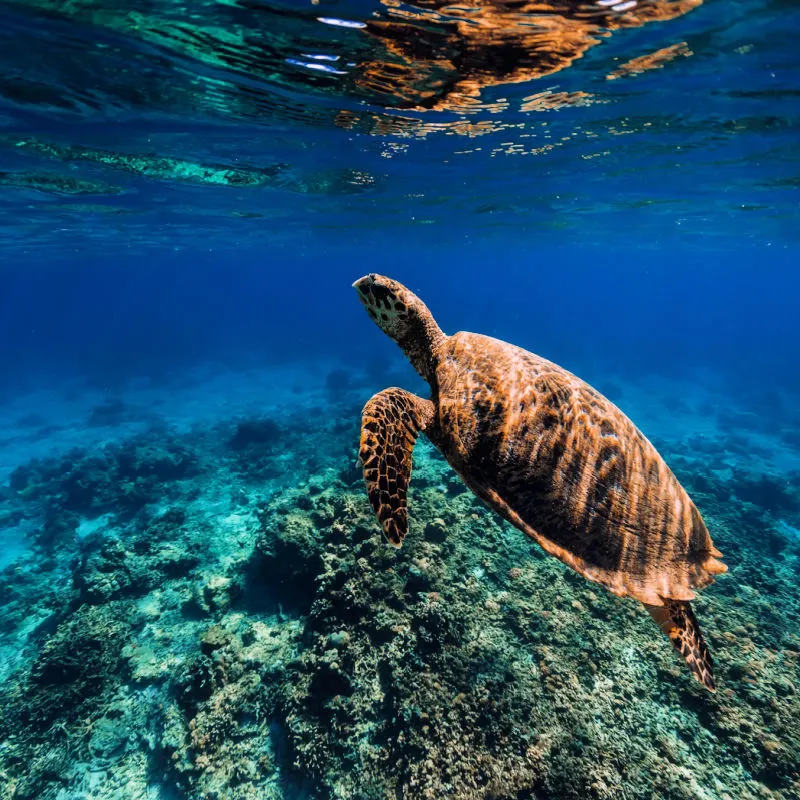
Amed's coastline hosts resident populations of green sea turtles at shallow, accessible snorkel sites within meters of shore. Three sites—Jemeluk Bay, the Japanese Shipwreck, and Lipah Beach—offer near-daily sightings in water calm enough for first-time snorkelers.
Quick answer
Amed snorkeling with turtles centers on Jemeluk Bay and Lipah Beach, where green sea turtles graze seagrass beds in two to six meters of water. Both sites are free-access public beaches open year-round. Mornings between 7:00 and 10:00 deliver the clearest visibility and calmest conditions before afternoon winds arrive. Sightings occur on approximately 85 percent of morning dives, dropping to 60 percent after midday when turtles retreat to deeper water.
Green sea turtles inhabit Amed's shallow reefs year-round because the coastline offers what few other Bali sites provide: contiguous seagrass meadows within swimming distance of shore. Adult turtles, some exceeding one meter in length, graze the same patches daily, making repeat encounters predictable. The volcanic sand substrate and offshore currents filter particulates quickly, keeping visibility between 12 and 20 meters most mornings. Jemeluk Bay anchors the turtle snorkeling corridor. The bay's sheltered crescent traps calmer water than exposed coastline, and seagrass beds begin five meters from the beach. Turtles surface every four to seven minutes to breathe, spending the intervals cropping algae from coral rubble. Lipah Beach, one kilometer south, attracts smaller juveniles near the reef wall where black coral and staghorn formations provide cover. The Japanese Shipwreck site between the two holds the largest single population, but requires a longer surface swim and draws stronger currents during tidal shifts. Snorkeling Amed's turtle sites requires no boat transfer or guide booking. Each site has roadside parking, and entry points are marked by warungs offering gear rental. Water temperature holds steady at 27–29°C year-round, eliminating wetsuit requirements. The reef slopes gently to 12 meters before dropping steeply, keeping most turtle activity within freediving range. Monsoon swells between December and February reduce visibility and push turtles deeper, but do not eliminate sightings. Conservation protocols prohibit touching, chasing, or blocking turtle movement. Indonesia classifies green sea turtles as protected under the 1990 Conservation Act, and Amed's reef managers enforce a three-meter minimum distance. Flash photography startles surfacing turtles and is prohibited at all sites. Feeding turtles or discarding food waste near seagrass beds disrupts natural grazing patterns and incurs fines under local bylaws. Most snorkelers see multiple turtles per session without violating approach distances, as the animals tolerate still observers and often surface within arm's reach when undisturbed.
“Green sea turtles inhabit Amed's shallow reefs year-round because the coastline offers contiguous seagrass meadows within swimming distance of shore.”
The best arrival window is 07:00–10:00, when calmer waters and higher visibility provide the most favorable conditions for observing turtles. Arriving during this period helps you avoid the stronger afternoon winds and changing tides that typically reduce water clarity.
Sunny, 27–30°C. Lower humidity levels favor underwater visibility.
Humid, 28–32°C. Potential for afternoon rain and currents.
—; Preferred for quiet observation of turtle habitats before local activity increases.
Verdict: For the highest chance of clear water and turtle sightings, aim for an arrival between 07:00 and 10:00 during the dry season months of April to October.
The Amed coastline is accessible to visitors throughout the week, offering continuous access for snorkeling activities along the beach.
Access to the Amed coastline for snorkeling is provided free of charge. Visitors may encounter minor parking fees at specific beach access points.
Verdict: A typical visitor pays 0 IDR for admission, though small parking fees may apply depending on the chosen beach access point.
The Amed coastline is situated in the Abang district of the Karangasem Regency. Visitors typically arrive via private transport or taxi, navigating the main coastal road that connects the various bays.
Jalan Raya Amed from Denpasar via Amlapura
Direct transfer from Ngurah Rai International Airport
Access points along the Amed Coastline
Head directly to designated beach access points where parking is available for a small fee. Once parked, turtle viewing areas are accessible by walking from the shoreline.
The waters off Amed serve as a significant corridor for migratory marine life, frequently hosting specific species of sea turtles. Understanding their natural behaviors and presence helps observers appreciate the local marine ecosystem during snorkeling activities.
The most common species in this region is the Green Sea Turtle, often identified by its heart-shaped carapace and herbivorous diet consisting primarily of seagrass and algae.
Recognizable by their narrow, bird-like beaks, Hawksbill turtles are occasionally sighted near Amed's coral reefs where they forage for sea sponges.
Turtles in these waters are frequently observed feeding on reef-associated vegetation during the early morning hours.
While turtles spend most of their time submerged, they must surface to breathe air, typically returning to the surface every few minutes depending on their activity level.
Sea turtles are predominantly solitary creatures, only congregating in larger numbers during specific breeding seasons or in areas with high food abundance.
Adult Green and Hawksbill turtles in this area typically range in length from 70 to 120 centimeters, depending on the age and health of the individual.
Green turtles feed and rest along Amed's reefs year-round. Maintaining distance and minimizing disturbance protects their natural behavior and ensures the population remains accessible to future snorkelers.
Everything you need to know about amed snorkeling turtles
Yes, sea turtles are resident to these waters and can be spotted throughout the year while exploring the local coastline. Because they live in their natural habitat, sightings depend on ocean conditions and timing rather than seasonal migrations.
Jemeluk Bay and the Japanese Shipwreck are frequently cited as the premier locations for this marine activity. Both sites offer accessible reefs where sea life, including protected green turtles, often graze on seagrass.
No, there is an entrance fee of 0 IDR to access the beach areas for snorkeling. While there is no cost for public entry, please note that small parking fees may apply at specific beach access points managed by locals.
The best arrival window is 07:00–10:00 to ensure you encounter calmer waters and higher visibility. This timeframe allows you to enjoy the reef before the midday winds and afternoon tides alter the water clarity.
The shallow, calm nature of many Amed bays makes them suitable for family excursions, provided children have appropriate gear and supervision. Always monitor ocean currents closely, as the coastline is an open marine environment.
It is recommended to bring your own high-quality mask, snorkel, and fins for the best experience. Consider bringing reef-safe sunscreen, a waterproof bag for your belongings, and plenty of drinking water for your time at the shore.
Guided Amed Snorkeling Tours
Read more GuideAmed Snorkeling Prices & Packages
Read more GuideBest Snorkeling Spots in Amed
Read more Tickets & toursPrivate Snorkeling Tours
Read more GuideAmed Snorkeling Map & Guide
Read more Tickets & toursAmed and Tulamben Snorkeling
Read more