
3 hr
Amed Underwater Temple & Shipwreck Snorkeling Adventure
Discover four stunning snorkel sites including a submerged temple, WWII wreck, and turtle sanctuary
Reserve
Hand-picked by our editors — only the best 5 snorkeling adventures from 12 reviewed.
Verified partners for every tour, free cancellation where available, and instant confirmation on every booking.
3 hr
Discover four stunning snorkel sites including a submerged temple, WWII wreck, and turtle sanctuary
Reserve
3 hr 30 min
Discover Bali's underwater treasures on a personalized 3.5-hour snorkeling journey to four exceptional marine locations.
Reserve
3 hr
Explore Bali's premier underwater sites with a complete snorkeling package at three stunning coastal locations
ReservePrices from verified partners. Availability updates in real time at checkout. Free cancellation policies apply where shown.
The landmarks, rooms, and views travelers on this tour remember — all visible on a single visit.
A world-famous wreck sitting in shallow water near Tulamben, covered in vibrant corals.
A protected bay in Amed providing easy shore access to diverse fish populations.
A shallow reef section near Tulamben perfect for spotting turtles and reef sharks.
A smaller, accessible wreck located in Amed, surrounded by colorful soft corals.
A secluded spot known for healthy coral cover and abundant macro marine life.
They complement each other; most visitors who do both call the Tulamben shipwreck the more thrilling encounter. Whether seeking vibrant coastal coral or historical remnants, booking amed & tulamben snorkeling tours allows for a complete survey of the region.
| Feature | Top pick Amed Reefs | Tulamben Wreck |
|---|---|---|
Underwater topography |
Shallow fringing reefs and walls | |
Primary marine life |
Tropical fish and coral colonies | |
Accessibility from beach |
Direct shore entry | |
Recommended skill level |
Beginner to advanced | |
Depth of interest |
3–10 meters | |
Historical context |
— | USAT Liberty shipwreck |
| See tickets → |
Verdict: Choose Amed for leisurely reef exploration, or select a Tulamben wreck snorkeling tour to witness the massive, marine-encrusted hull of the USAT Liberty. Visitors often seek amed & tulamben snorkeling tickets to experience both distinct underwater worlds during their stay.
Choose your ticket, select your date, and reserve in under two minutes. Secure checkout handled by our verified partner.
Instant confirmation by email, with a mobile voucher you can save offline. No printing, no queuing at a collection desk.
Arrive at the entrance, show your voucher on your phone, and walk in. Most tickets include priority or skip-the-line access.
Practical details for your visit straight from our verified partners — hours, access, rules, and how to get there.
Amed, Bali
Primary meeting point for morning tours.
Private transport is the most reliable way to reach remote sites.
No specific dress code is required for the beach, but modest clothing is recommended when traveling through local villages in Karangasem Regency. Always wear swimwear appropriate for active water sports.
There are no secure lockers at public access points for amed & tulamben snorkeling. It is advised to travel light and keep valuables at your accommodation.
Underwater photography is common; ensure your camera has a waterproof housing. Respect other snorkelers by maintaining distance while capturing images during your amed & tulamben snorkeling tour.
Access to the water at Amed and Tulamben involves walking over volcanic pebbles or rocky paths. Mobility assistance is not standard at these natural coastal locations.
Mobile signal is generally reliable, but waterproof cases are essential to protect devices from saltwater. Avoid using phones while navigating the rocky shoreline.
Families should supervise children closely at all times due to varying currents. Many local operators offer life vests for younger swimmers participating in amed & tulamben snorkeling.
Numerous small cafes known as warungs are located near the shore in Amed and Tulamben. These venues provide hydration and local cuisine after your amed & tulamben snorkeling session.
Pets are not restricted from the public beach areas, but they are generally not suitable for boat-based snorkeling excursions.
Always prioritize safety by checking current weather conditions before entering the water. Local guides are available to hire for those seeking the best visibility and safety during amed & tulamben snorkeling.
Best time to go, insider tips, nearby landmarks, and the cancellation fine print — flip through to skim what matters to you.
How crowds, weather, and events shift across the year.
April to June offer calm waters and high visibility for amed & tulamben snorkeling tickets.
Small details that turn a good visit into a great one.
Consult local diving schools for daily reports on water clarity.
Non-bookable sights within a short walk — free to visit, easy to pair.
Renowned cultural site featuring high-altitude views.
Popular area for snorkeling with deep water drop-offs.
Historic water garden in the Karangasem Regency.
Flexible, no hidden fees.
As this involves local operators, please check your specific booking confirmation for refund windows. Entrance fees are 0 IDR as these are public beaches.
Hand-picked options within walking distance — pick a district for vibe, or a specific hotel for convenience.
Diverse selection of beachfront villas and bungalows.
Convenient access to the world-famous shipwreck site.
Local guest houses offering authentic experiences.
The USAT Liberty lies thirty meters offshore in fifteen meters of water, her bow encrusted with soft coral forests that predate most visitors by two decades. The American cargo ship ran aground on Tulamben's volcanic sand in 1942 after a Japanese torpedo struck her hull east of Lombok Strait. Local salvagers stripped her fittings until Mount Agung's 1963 eruption shoved the wreck off the beach and into the shallows, where she settled on her starboard side and became East Bali's most accessible dive site. Snorkelers who arrive early see jackfish and barracuda patrol her superstructure while the surface remains glassy. Amed's seven-kilometer coastline runs north from Jemeluk Bay to Lipah Beach, each cove rimmed by black volcanic sand and shallow reef platforms that drop into blue water within fifty meters of shore. Traditional jukung outriggers ferry snorkelers to sites unreachable by foot: the Japanese Shipwreck at Banyuning, the submerged temple ruins at Jemeluk, and the coral bommies off Bunutan where humphead parrotfish graze on algae. The reefs here escaped dynamite fishing that scarred southern Bali in the 1980s, and water clarity routinely exceeds thirty meters during the dry season. Visibility declines between December and March when northwest monsoon swells stir sediment, but the underwater topography remains navigable year-round. Karangasem Regency's volcanic geology shapes the diving. Mount Agung's 1963 lava flows created the black sand beaches, while mineral-rich freshwater springs bubble through the reef at Jemeluk Bay, attracting schools of fusiliers and triggering algae blooms that feed herbivorous fish populations. The cold-water upwellings that surge through Lombok Strait bring nutrients and pelagic species uncommon elsewhere on Bali's coasts. Reef composition tilts toward hard corals — table corals, staghorns, brain corals — rather than the soft coral gardens that dominate southern Bali's walls. Snorkeling Amed and Tulamben requires no certification, but surface currents strengthen after midday as thermal winds accelerate down Agung's slopes, and tour operators schedule morning departures to avoid the chop.
"The USAT Liberty lies thirty meters offshore in fifteen meters of water, her bow encrusted with soft coral forests that predate most visitors by two decades."
A step-by-step walkthrough of the visit — what you'll see, how long each stage takes, and the details that matter.
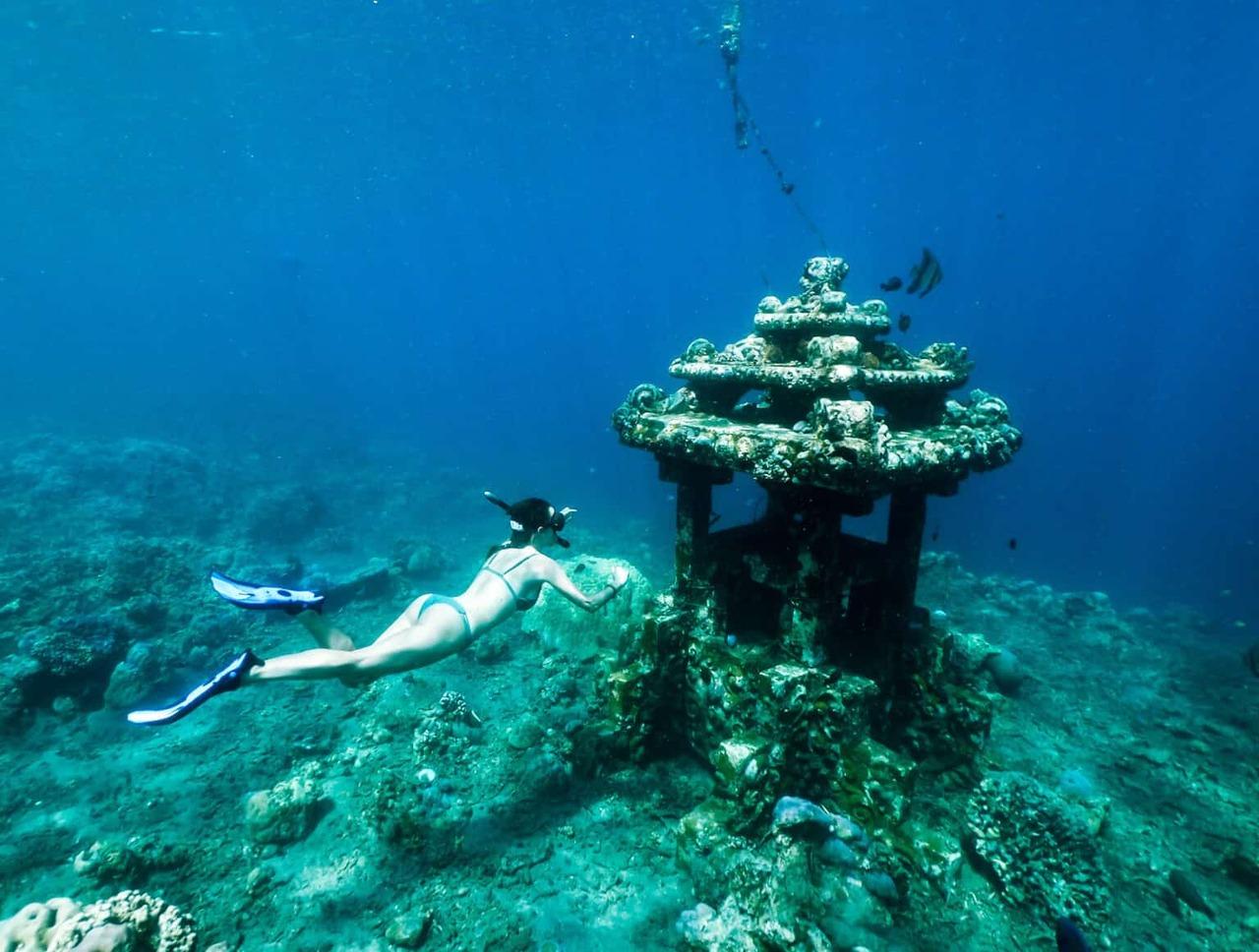
You meet your guide at Jemeluk Bay at first light, fins and mask already distributed as the jukung's outrigger hulls scrape across volcanic sand. The wooden boat cuts north past Lipah Beach, and within ten minutes you're floating above the submerged temple, its stone gates blurred by twenty meters of blue-green water. You descend along the mooring line, equalizing pressure every few kicks, until the structure sharpens — carved lintels, a ceremonial platform, votive niches still holding offerings placed by freediving locals. The jukung repositions to the Japanese Shipwreck for the second drop. Rusted hull plates angle upward from the sand, schooling glassfish reflecting morning sun through the surface. You fin slowly along the wreck's spine, pausing when a hawksbill turtle lifts off the bottom and glides past your shoulder. Your guide signals toward a crevice where a moray eel retracts into shadow. After forty minutes you surface and motor south to the USAT Liberty, where you drift along the bow section, watching jackfish spiral above the cargo holds and butterflyfish dart between coral branches that have colonized the deck rails. The water temperature drops a degree as an upwelling current sweeps through, and you pull closer to the reef wall until the guide signals the return to shore.
The beaches are accessible 00:00–23:59 daily.
Entry is 0 IDR at public beaches, though small parking fees may apply.
The best arrival window is 06:30–11:00 to ensure calm waters and optimal light.
No, secure lockers are not provided, so keep valuables at your accommodation.
Yes, children can join, but ensure they have appropriate life vests and supervision.
Access involves navigating rocky or pebbly shorelines which can be uneven.
Booking amed & tulamben snorkeling tours in advance is recommended to secure a local guide.
Yes, you are welcome to bring your own equipment if you prefer.
Yes, various local warungs are located near the shore for food and drinks.
Yes, photography is encouraged, but maintain a safe distance from the marine life.